Review: The Asus ProArt P16 Offers a Glimpse of Local AI
Costing up to $7,000, the Asus ProArt P16 laptop runs a variety of local AI agents powered by an Nvidia GPU.
Ars Technica
Updated · 2 min read
Overview
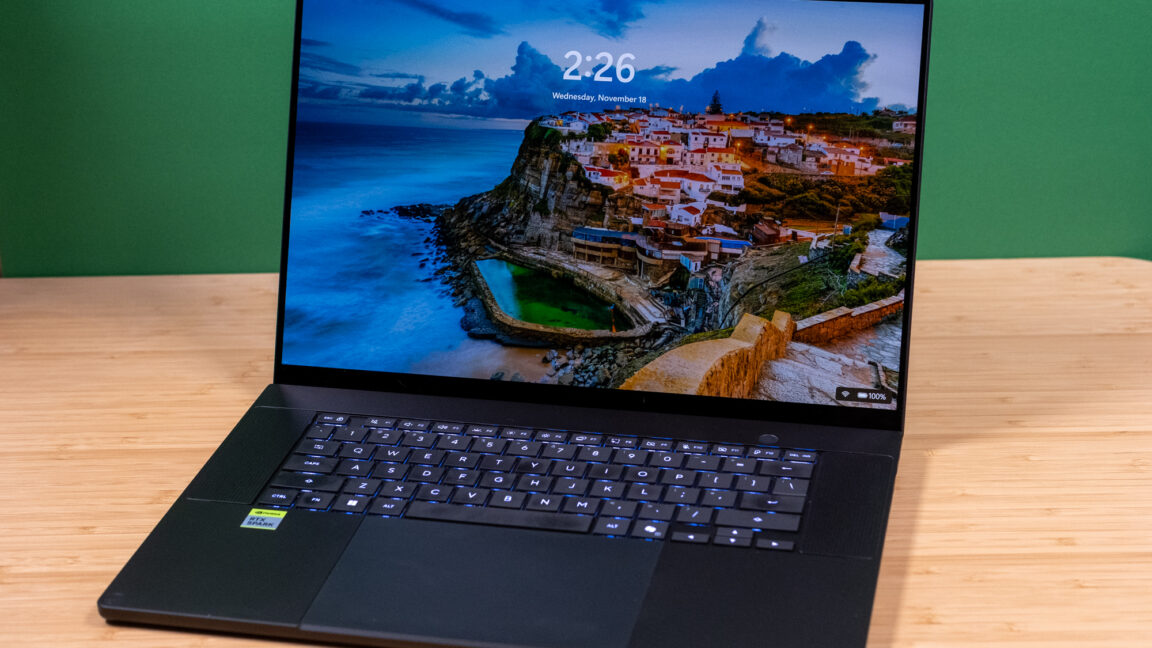
The Asus ProArt P16 laptop provides a look into a future driven by local artificial intelligence. Priced up to $7,000, the machine is capable of running multiple local AI agents and features powerful hardware configuration options [s1].
At the heart of the system's graphics and AI capabilities is the Nvidia GB20B Blackwell GPU. This setup enables advanced computational power, though users must handle substantial configuration and management when utilizing third-party tools [s1].
Hardware and Performance
The laptop features the Nvidia GB20B Blackwell GPU, which packs 6,144 cores across 48 streaming multiprocessors and a 24MB L2 cache. Its 5th-generation Tensor Cores support Nvidia technologies like DLSS, Reflex, ACE, G-Sync, CUDA, and NVFP4. Overall, the system delivers up to 31 TFLOPS of FP32 graphical performance and roughly 1,000 TOPS of FP4 AI compute [s1].1
AI Setup and Management
With an RTX Spark laptop, users maintain total control over AI operations, which requires manual setup and management. While Asus includes a few apps to streamline specific AI tasks, installing third-party agents introduces more complex operational workflows. Nvidia's chip is optimized for desktop clients such as OpenClaw and Hermes, providing simple graphical UIs to download chosen AI models [s1].1
Tested Models
Testing on the laptop included various AI models across different size ranges. Asus recommends starting with Qwen 27B, a Mixture-of-Experts model balancing size and efficiency. Reviewers also loaded multiple versions of Google's Gemma open models in a similar size range [s1].1
Key takeaways
- The Asus ProArt P16 laptop costs up to $7,000.
- It runs on the Nvidia GB20B Blackwell GPU, supporting up to 1,000 TOPS of FP4 AI compute.
- Users have total control over AI operations, requiring personal setup and management of third-party agents.
- Recommended models to start with include the Qwen 27B Mixture-of-Experts model and Google's Gemma open models.
Why this matters
The Asus ProArt P16 highlights the growing trend and hardware capabilities required for running complex AI models locally on consumer devices. It demonstrates the intersection of high-end graphics architecture and desktop AI client optimization, while exposing the current hurdles of user management and high financial cost.
Original reporting
1 article from 1 publication. Read the full reporting at the source.
Related stories

Nvidia RTX Spark Mini PCs Launch from Asus, Dell, and MSI

Amazon Acquires AI Startup Decart’s Technology and Talent for $7.5 Billion
