Democrats Secure Control of Congress Following 2026 Midterm Elections
The 2026 US midterm elections resulted in Democratic majorities in both the House and Senate, creating a period of divided government.
Dentons
Updated · 2 min read

Overview
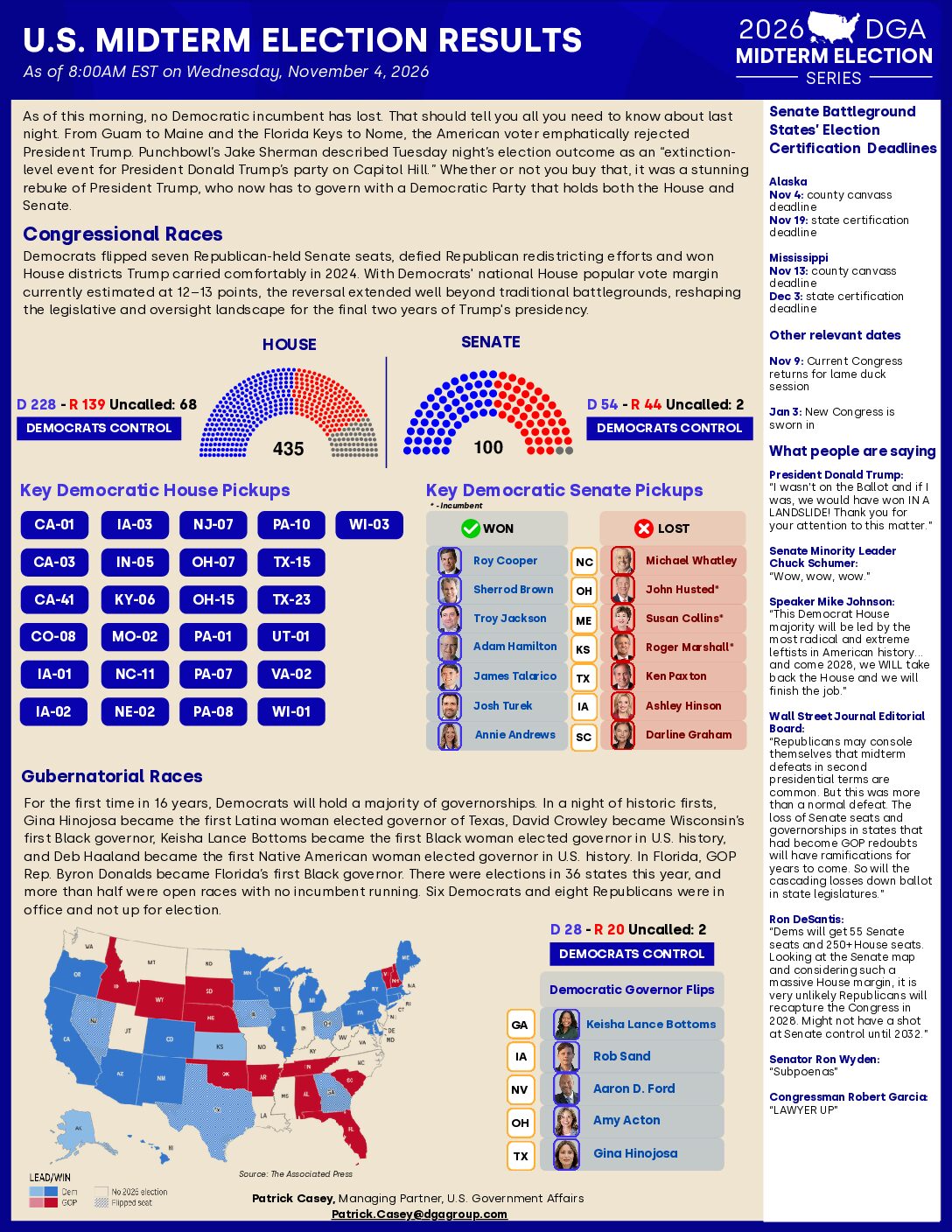
The November 3, 2026, midterm elections led to significant shifts in the American political landscape. Democratic candidates achieved a series of upsets across the country, securing control of both chambers of Congress and making gains at the state level, including in traditionally Republican states.
These results establish a period of divided government for the remainder of President Trump’s term. While the Democratic majorities do not constitute a veto-proof threshold, the shift in legislative power is expected to influence federal oversight, energy policy, and regulatory priorities.
Congressional Shift
The election outcomes significantly altered the composition of Congress. The Senate saw a gain of 9 Democratic seats, resulting in a total of 56 Democratic senators. In the House, Democrats achieved a net gain of 42 seats, bringing their total representation to 257 members. [s1]1
Policy Implications
The new political alignment is anticipated to impact various sectors, including trade, investment, technology, and supply chains. Specifically, the change in legislative control is expected to influence federal energy policy and broader regulatory landscapes. Businesses are advised to monitor these developments as they navigate potential changes in geopolitical risk and state-level policymaking. [s1]1
Key takeaways
- Democrats gained control of both the House and the Senate in the 2026 midterm elections.
- The Senate now holds 56 Democratic seats, while the House has 257.
- The election results create a period of divided government for the remainder of President Trump's term.
- The new majorities are not large enough to be considered veto-proof.
Why this matters
The shift in congressional control creates a divided government that will likely alter federal oversight and policy direction. This transition carries implications for businesses operating in sectors such as energy, technology, and international trade.
Original reporting
1 article from 1 publication. Read the full reporting at the source.
Related stories

Democrats Prepare Legislative Agenda Following 2026 Midterm Election Results
Democrats Consider Legislative Strategy Following Midterm Election Gains
