Dark Energy Survey Results Suggest Potential Flaws in Standard Cosmological Model
A seven-year analysis of hundreds of millions of galaxies indicates that dark energy may be weakening over time, challenging the long-held Lambda-CDM theory.
Quanta Magazine
Updated · 2 min read
Overview
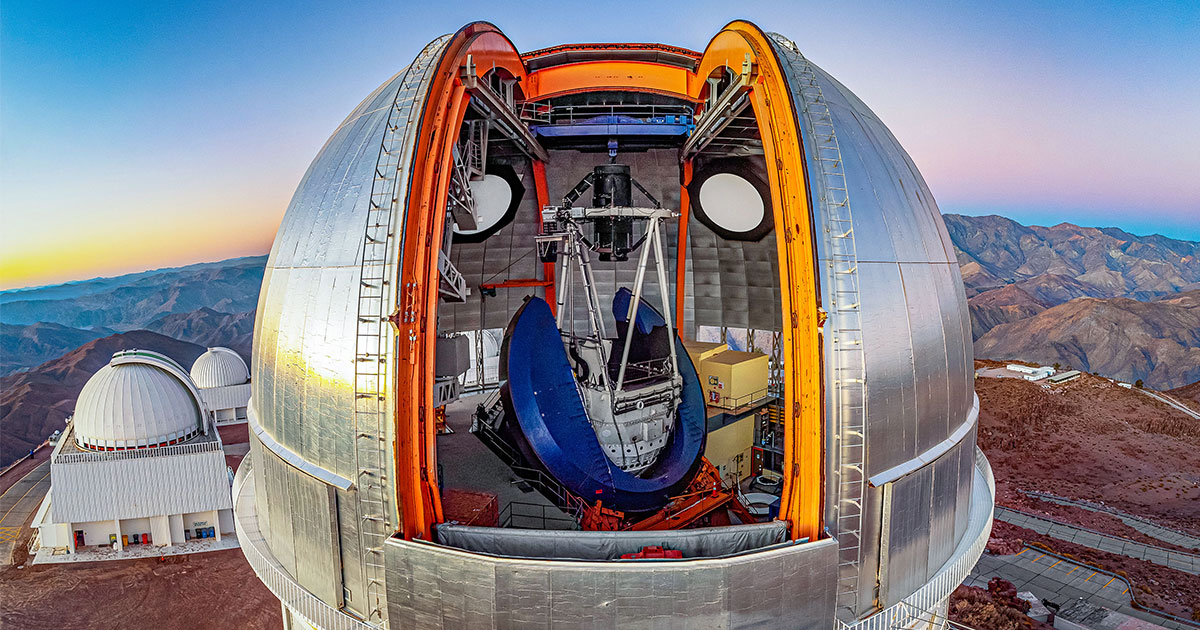
The Dark Energy Survey (DES) collaboration has released its final results after seven years of rigorous analysis, providing the most detailed view of the modern universe to date. By examining distortions in the positions and shapes of hundreds of millions of galaxies and re-analyzing a catalog of 1,600 supernovas, researchers have compiled a comprehensive map of cosmic history.
The findings suggest that the standard model of cosmology, known as Lambda-CDM, may not fully account for the universe's evolution. Instead, the data shows a statistical preference for a theory where dark energy is not a constant force but has slackened in recent eons, potentially requiring a significant revision of our understanding of the cosmos.
A Comprehensive Cosmic Map
The DES collaboration utilized seven years of data to compare pairs of galaxies, looking for minute distortions that reveal how matter clumps together. This effort was combined with a reprocessed catalog of 1,600 supernovas and data from the Dark Energy Spectroscopic Instrument (DESI) to create the thickest file on the universe to date.1
Challenging the Lambda-CDM Model
When merging their matter maps with Cosmic Microwave Background (CMB) images, researchers found that the standard Lambda-CDM model did not fit the data well. The analysis revealed a 'three-sigma' statistical preference for a model where dark energy is unstable and has weakened over time.1
Key takeaways
- The Dark Energy Survey (DES) published its final results in early 2026 after seven years of analysis.
- The study analyzed hundreds of millions of galaxies and 1,600 supernovas to map the modern universe.
- Data suggests dark energy may have slackened in recent eons rather than remaining stable.
- The findings show a 'three-sigma' statistical preference for an evolving dark energy model over the standard Lambda-CDM theory.
Why this matters
These results challenge the fundamental assumption that dark energy is a constant force, which is a cornerstone of modern cosmology. If dark energy is indeed changing, it would require scientists to develop new theories to explain the expansion and ultimate fate of the universe.
Perspectives
How different voices in the coverage frame this story.
Scientific Validation
External researchers like Ferraro describe the DES analysis as a 'tour de force' that pushed cosmic measurement to a new level of precision.
Source: Quanta Magazine
Data Reliability
Some cosmologists, such as Seshadri Nadathur, express higher confidence in the DES-reanalyzed supernova data compared to other existing datasets.
Source: Quanta Magazine
Original reporting
1 article from 1 publication. Read the full reporting at the source.
Related stories
Researchers Investigate Mysterious Polarization Twist in the Universe's Oldest Light

How Decades of Null Results Led to the Discovery of Gravitational Waves